Easy Overnight No-Knead Dutch Oven Bread
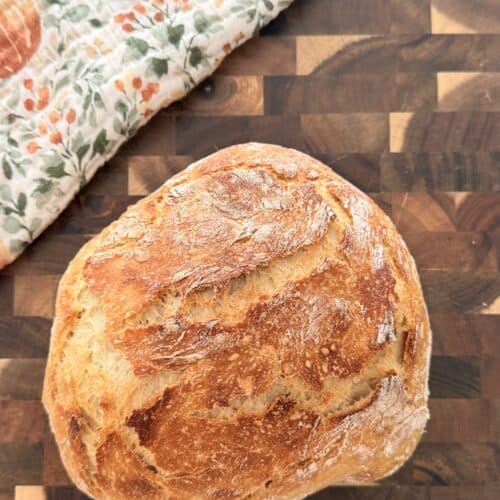
This easy no-knead Dutch oven bread uses instant yeast and a touch of honey to create a crisp, golden crust and soft, chewy center—no mixer, kneading or pioneer-level commitment required.

Equipment
- dutch oven
Ingredients
- 3 cups all-purpose flour (plus more for shaping)
- 1½ tsp salt
- ¾ tsp instant yeast
- 1 Tbsp honey
- 1¾ cups warm water approximately 105–110°F (plus 1–2 tablespoons more if needed)
Instructions
Mix and Let the Dough Rise
- In a large mixing bowl, whisk together the flour, salt and instant yeast.
- Stir the honey into the warm water until dissolved. Pour the mixture into the dry ingredients and stir with a wooden spoon until no dry pockets of flour remain.
- The dough should look wet and shaggy and should feel very sticky—it will cling to the spoon and your hands. If the dough still looks dry, feels firm or has loose flour at the bottom of the bowl, add additional warm water 1 tablespoon at a time until it reaches the proper consistency. Do not add extra flour simply because the dough feels sticky.
- Cover the bowl tightly with plastic wrap or cover with a kitchen towel. Let the dough rise at room temperature until it has expanded and the surface looks bubbly and is beginning to flatten.
Rising time will depend on the temperature and humidity in your kitchen:
- * A warm, humid kitchen like mine in Florida may require only 6–8 hours. * Begin checking the dough after 6 hours. Moderately cool kitchens may require approximately 8–12 hours.* Colder kitchens may extend the rising time to as long as 18 hours.
- Watch the dough instead of relying only on the clock. Dough that rises too long may lose its structure and become difficult to shape.
Preheat the Dutch Oven and Shape the Dough
- Place a covered 6-quart Dutch oven inside the oven and preheat to 450°F. Allow the Dutch oven to heat for 30–45 minutes before baking the bread.
- Generously flour a clean work surface and your hands. Use a a spatula or clean hands to turn the dough onto the floured surface and lightly dust the top with flour. Working quickly, fold two opposite sides toward the center. Turn the dough over and gently shape it into a round loaf by rotating it and pulling the edges underneath.
- Transfer the shaped dough to a lightly floured piece of parchment paper. Cover it loosely with plastic wrap and let it rest for 30 minutes.
- Trim the parchment paper if needed, leaving enough around the dough to help you lift it safely.
Bake and Cool the Bread
- Carefully remove the hot Dutch oven and take off the lid. Use the parchment paper to lower the dough into the pot. Replace the lid and return the Dutch oven to the oven.
- Bake the bread covered for 30 minutes. Carefully remove the lid.
- Continue baking uncovered for 10–15 minutes, or until the crust is deeply golden. The bread should sound hollow when tapped and register approximately 200–210°F in the center.
- Carefully lift the bread out of the Dutch oven and transfer it to a wire rack. Let it cool for at least 1 hour before slicing. The center continues to set as the bread cools, so resist the urge to cut into it immediately—even though your kitchen now smells like a bakery.
Notes
A Note About Rising and Baking Times
- All rising and baking times are approximate because kitchen temperature, humidity, Dutch oven material, and individual ovens can affect the bread.
- In a warm, humid climate like Florida, the dough may rise faster and could be ready in approximately 6–8 hours.
- In a cooler kitchen, it may need 12–18 hours.
- Watch the dough instead of relying only on the clock.
- It is ready when it has expanded, looks bubbly, and is beginning to flatten on top. If it rises too long, it may lose structure and become difficult to shape.
- The total time listed in the recipe card is based on an 8-hour rise. Your actual time may be shorter or longer depending on the conditions in your kitchen.
Nutrition
Calories: 147kcal | Carbohydrates: 31g | Protein: 4g | Fat: 0.5g | Saturated Fat: 0.1g | Polyunsaturated Fat: 0.2g | Monounsaturated Fat: 0.1g | Sodium: 468mg | Potassium: 53mg | Fiber: 1g | Sugar: 2g | Vitamin A: 1IU | Vitamin C: 0.01mg | Calcium: 7mg | Iron: 2mg
Disclaimer: All nutrition values are per serving and approximate. They will vary depending on products and quantities used.
